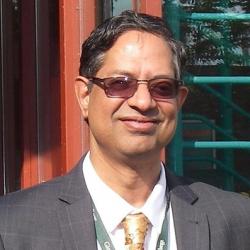
Gopal Madabhushi

Insights into the physical modelling of problems in geotechnical earthquake engineering

Abstract

This lecture focuses on several aspects of geotechnical earthquake engineering that were dear to late Prof Andrew Schofield. The first of these is the choice of earthquake input motions that may be used to shake a centrifuge model in-flight. The evolution of mechanical earthquake actuators from leaf-spring to bumpy road and then the Stored Angular Momentum (SAM) actuator will be presented. The current capabilities of servo-hydraulic earthquake actuators and the requirement for specialist model containers such as Equivalent Shear Beam containers and laminar boxes to simulate liquefaction induced lateral spread problems will be highlighted. Use of sinusoidal motion versus more complex motions such as previous historic earthquakes like Kobe or Northridge and their relative merits will be discussed.

Next the soil liquefaction and modelling of this phenomena in dynamic centrifuge tests will be presented. The soil behaviour quite close to liquefaction will be explained using the critical state frame work, where the soil stress path goes close to the fracture line. This results in the phenomena of sand boils, mud volcanoes etc. as the permeability and compressibility of the liquefied soil changes by several orders of magnitude. The observation of these using centrifuge test data and consequences of this to foundations located on liquefiable soil surface will be detailed. The lecture will bring to fore the insights provided by Prof Schofield and how this shaped the evolution of research on soil liquefaction.

Biography

Professor Gopal Madabhushi leads a research group on geotechnical earthquake engineering. Professor Madabhushi has wide-ranging interests in this field from post earthquake field investigations to experimental and numerical investigations of liquefaction induced failure mechanisms of civil engineering structures. He served as the chairman of EEFIT (Earthquake Engineering Field Investigation Team) that operates under the auspices of Institution of Structural Engineers, London and continues as the member of the Missions Expert Group (MEG). He is a member of the Research and Education sub-committee of SECED. He is also a member of the Technical Committee TC2 of ISSMGE and heads the sub-committee on Teaching Resources. He is the Associate Editor of the Journal of Geotechnical Earthquake Engineering and serves as the Editorial Board member of Geo-mechanics Engineering (GAE) Journal. Professor Madabhushi’s research has been funded by EPSRC, EU, NSF USA, Newton Trust, Santa Clara University, USA, Mott MacDonald, UK, Shimizu Corporation, Japan. Many boundary value problems have been studied ranging from liquefaction induced lateral flow past piles supported by Shimizu Corporation, plastic buckling of piles, liquefaction-induced settlement of rock fill dams etc. In a recent project the dynamic soil-structure interaction of foundations of heavy structures such as Nuclear Reactor Buildings that are founded on stratified soil. Professor Madabhushi has a strong interest in Finite Element analyses of liquefaction problems. The FEA have been used to investigate many boundary value problems including the sheet pile walls, dynamic SSI problems with heavy foundations etc.

Schofield Lecture